|
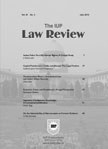
Indian Police Vis-à-Vis Human Rights: A Critical Study
--A Padmavathi
Human rights are generally defined as “those rights which are inherent in our nature and without which we cannot live as human beings”. Human rights and fundamental rights are the birth right of all human beings and they are now recognized as the limit to the exercise of power by the State over individuals. The primary duty of the police is to safeguard the lives as every human being has inherent right to life and personal liberty1 and there shall not be any arbitrary arrest or detention or threat to life and liberty. Custodial death and custodial rapes are the glaring examples of the violation of human rights. The efficiency of the fundamental right is jeopardized when the law enforcing agencies themselves become obnoxious. Besides recounting the recommendations made by several committees that enquired into the subject with a view to augmenting better protection of human rights of citizens while in police custody, the paper also makes suggetions. © 2013 IUP. All Rights Reserved.
Capital Punishment in India and Abroad: The Legal Position
--Audhinarayana Vavili and R Rajkumar
The debate over capital punishment has surfaced once again on public domain due to the recent executions and decisions of the Supreme Court. This has been the bone of contention between the retentionists and abolitionists of capital punishment for a long time. Capital punishment has prevailed since the existence of humanity. The opponents argue that ultimate punishment is inhumane and it is nothing but killing by an authority. They further argue that capital punishment is irreversible and uncorrectable and human judgment is fallible. The retentionists argue that capital punishment should stay as it deters crime. There is truth in both the contentions. This paper analyzes the position of law on capital punishment in India and across the globe and the recent decisions of the Apex court in this regard. © 2013 IUP. All Rights Reserved.
Transboundary Rivers, International Law
and India’s Water Security
--J Uma Rao
This paper is an attempt to examine India’s water security in the present scenario of its fast dwindling water resources and aggressive posturing by China which plans to subvert Brahmaputra waters. This paper critically examines the treaties that India has so far entered into with its neighbors regarding the use of its transboundary river waters, their applicability to the water sharing conflict with China, various doctrines including the Helsinki Rules and the UN Convention of 1997, how they have been adhered to and used by different countries as well as how they can be invoked to meet India’s water security. © 2013 IUP All Rights Reserved.
Economic Crime and Punishment: A Legal Perspective
--Ravulapati Madhavi
Crime speaks of the degree of moral integrity of a society, and often depends, to a certain extent, on the culture of the society. Corruption has no race, religion, territory, sex or place of birth. It is all-pervasive and omniscient and is becoming omnipotent. Ironically, society views traditional criminals as those clad in terrifying blood-red color and calls them ‘condemned’, whereas those in high echelons committing colossal frauds are seen as gentlemen and hence their crimes are respectfully designated as ‘white collar crimes’. And so gracefully, the destiny of ordinary criminals is crematorium whereas the destiny of the elite economic offenders is moratorium. © 2013 IUP. All Rights Reserved.
Ingenuity of Indigenous Knowledge:
A Conceptual Justification
--Aarati Tyagi
The concept of ‘intellectual property’ is found to be the hallmark of human intelligence and finally human intelligence has landed on ‘tradition’ to churn out property. Industrially-civilized communities may not possess tradition as a source of property, but the sumptuous tribal communities possess a vast resource of traditional culture and cultured tradition. When we lose tradition, we become insipid. But when we lose Traditional Knowledge (TK), we are lifeless and extinct. Where tradition itself cannot be resurrected, there is clearly a need for alternative ways to keep TK alive. The TK of harmless tribal communities, underdeveloped and developing countries is devastatingly plundered by the so-called scientifically advanced nations to the detriment of human development and sustainable development theories, a menace to many of the African and Asian countries. Justice Krishna Iyer’s classical quote is worth mrntioning here: “In the guise of globalization, the developed countries are taking the developing countries for a ride”. This paper tersely enunciates the concept of TK and its utility for human kind and its role in the national economic fabric. © 2013 IUP. All Rights Reserved.
On the Admissibility of Narcoanalysis as Forensic Evidence
--Srishty Banerjee
The search for effective aids to interrogation is probably as old as man’s need to obtain information. Since time immemorial, man has been dreaming to know the truth of events. A few years back, things like ‘truth serum’ used to be the stuff of James Bond, Cold War, and KGB. It was hard to imagine that things like the administration of sodium pentothal and admissibility of narcoanalysis would have to be dealt with in the arena of law as a serious issue. The legal system should imbibe developments and advances that take place in science as long as they do not violate the fundamental legal principles and are for the good of the society. The main issue is the question of admissibility of narcoanalysis as a scientific technique in investigations and its ultimate admissibility in Court as forensic evidence. The Indian criminal justice system has an alarmingly low conviction rate and the situation needs to be rectified with emphasis on real science and state-of-the-art technology. It is time our legislature and judiciary acted immediately for the sake of justice and fair procedure to bring narcoanalysis within the scope of Article 20(3) of the Constitution. © 2013 IUP. All Rights Reserved.
|